
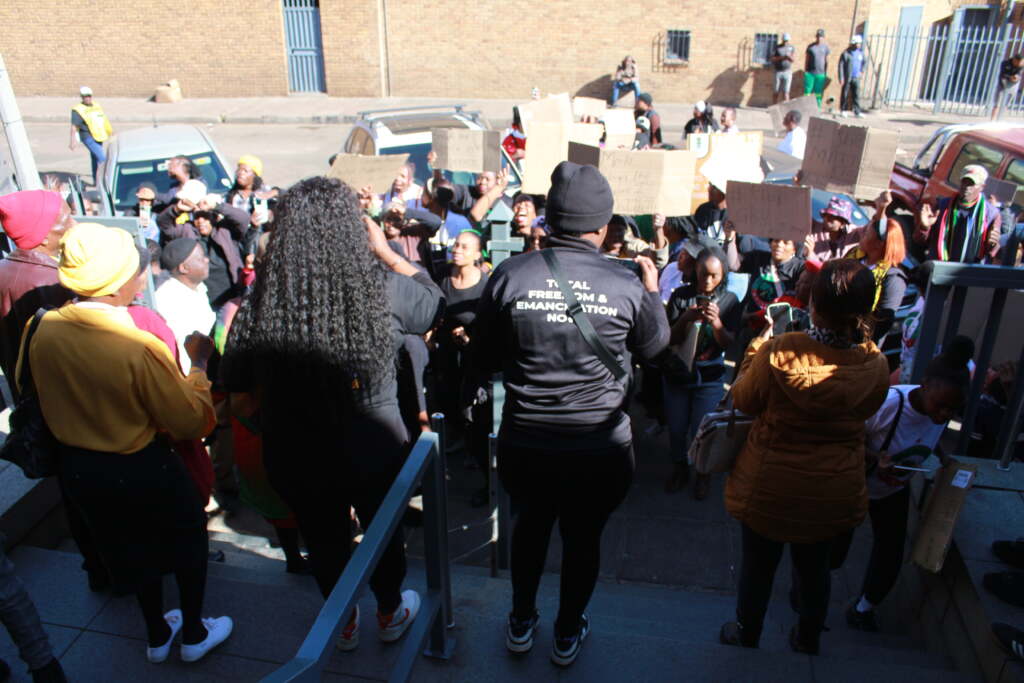
Women gather outside the eMalahleni Magistrate’s Court, holding placards as they call for justice to take its course.
Image: EN Reporter
The eMalahleni Magistrate’s Court became the latest flashpoint in South Africa’s war against gender-based violence (GBV) this week, as Mpilo Sibiya accused of murdering his girlfriend, Marchein Tlou abandoned his bail application.
Tlou’s body was discovered on 27 April 2026 in the couple’s rented room in Hlalanikahle Phase 4. Preliminary reports indicate she suffered a fatal throat wound. The brutality of her death has shaken the community, reigniting anger over the state’s failure to stem the tide of femicide.
Outside the courthouse, residents gathered in solidarity with the Tlou family. Their chants and placards were not just about one case, they were an indictment of a justice system that too often leaves women unprotected. For many, Sibiya’s decision to remain behind bars was seen as a small victory in a much larger war.
Audrey Mtsweni, representing SANCO in Mpumalanga, welcomed the outcome but issued a stark warning, as she stated that awareness campaigns alone will not dismantle entrenched violence. “We need communities to be educated on how to report cases of gender-based violence and where victims can receive assistance,” she said. Her words underscored a familiar frustration that government promises of action rarely translate into systemic change.
Mtsweni also pointed to the cultural roots of the crisis, insisting that prevention must begin at home. “The issue of GBV must also be addressed in homes while boys are still young, so they grow up knowing how to treat women,” she added.
President Cyril Ramaphosa has repeatedly described GBVF as South Africa’s “second pandemic.” Yet the numbers remain staggering, at least 15 women are murdered by their partners every day in this country. Studies show that more than half of South African women have experienced GBV, while three-quarters of men admit to perpetrating violence.
Despite billions pledged and new laws passed, civil society organizations argue that the state’s response has been piecemeal, underfunded, and reactive. Survivors continue to face stigma, trauma, and systemic neglect.
Government efforts to combat gender-based violence and femicide (GBVF) have intensified in recent years, with the launch of the National Strategic Plan on GBVF in 2020, supported by a R21 billion budget allocation. In 2024, the implementation of the National Council on GBVF Act established a statutory body tasked with coordinating the country’s response to the crisis. Meanwhile, the GBVF Response Fund has raised R162 million to support intervention programmes, although reports indicate that less than half of the funding has reached community-based organizations on the ground.
Critics say these measures look good on paper but fail in practice. Implementation is slow, funding is inconsistent, and survivors remain at risk.
South Africa’s policing and justice system continues to face mounting pressure amid the growing number of GBV cases, with detectives reportedly handling between 35 and 45 rape dockets at a time. The heavy caseload has contributed to delays in investigations and concerns over the quality of case management.
Survivors have also raised complaints about dismissive treatment, missing dockets and alleged corruption within the South African Police Service (SAPS), while court backlogs and poor coordination between police and prosecutors have left many cases unresolved. The result is a justice system that too often retraumatises survivors instead of protecting them.
Marchein Tlou’s murder is not an isolated tragedy. It is part of a national crisis that has been declared a priority by government but continues to devastate communities daily. While Sibiya’s bail abandonment may feel like a small victory, it does little to address the systemic failures that allow GBV to flourish.
The case resumes on 30 July 2026. Until then, the Tlou family waits for justice, while South Africa waits for a justice system capable of delivering it.